Showing posts with label Thailand. Show all posts

Sunday, 22 December 2019

2019 travel costs for Thailand

Back on my 2011 travels, I included a breakdown of travel costs for Thailand. I thought it might be useful to update those costs for my 2019 trip, as I spent 3 weeks in SE Thailand in July, a month in north and northeast Thailand in October, and 9 days in SW Thailand in December.

One caveat, my travel style has always been more flashpacker than backpacker, and is probably even more so, now I'm middle aged. I like AC. I hate share bathrooms. For convenience, I've broken the Thai portions of the trip down into different sections, as the costs do vary a little (with the islands costing noticeably more than the mainland).

Peninsular towns (Songkla, Phattalung, Nakhon Si Thamarat, Surat Thani, Chumphon, Prachuap Khiri Khan, Hua Hin, Trang, Satun): average costs per day = £26.29 (1045 THB)

Accommodation average £17 per night (675 THB)
  • Songkla - 1175 THB (£29). Songkla is very popular with domestic tourists, and I was there over a weekend, meaning most places were fully booked. I therefore had to take a more expensive room that I normally would.
  • Phattalung – 730 THB (£18.25) 
  • Nakhon Si Thamarat – 495 THB (£12.40) 
  • Surat Thani – 490 THB (£12.25) 
  • Chumphon – 622 THB (£15.50) 
  • Prachuap Khiri Khan – 570 THB (£14.25)
  • Hua Hin – 744 THB (£18.50)
  • Trang – 502 THB (£12.50)
  • Satun – 590 THB (£14.75)
Food and drink: average £5.50 per day (217 THB) – mostly cheap restaurants and a few food stalls, but no alcohol. Sample costs might be:
  • 30 THB for khao gaeng (curry rice) at a market stall
  • 20 THB for an iced coffee at a stall
  • 60-70 THB for an iced coffee at a fancy coffee shop
  • 90 THB for khanom jeen (a noodle dish), a sharing-sized side of goong tod (fried shrimp fritters) and an iced tea at a small restaurant.
Sightseeing is pretty cheap, as museum fees are generally not excessive (perhaps 100-150 THB) and that wandering around and visiting wats is largely free. Average £0.68 (27 THB) per day.

Transport is also affordable: I used a mix of trains and minibuses to move between towns, with  sorngtaews, the occasional taxi, or often just my feet to get around in town. Intercity train journeys varied between about 20 and 100 THB, depending on the distance (3rd class). Intercity minibuses varied between 80 and 180 THB. I typically spent an average of £1.62 (64 THB) per day.


Northern and NE Thailand (Chiang Mai, Chiang Dao, Thaton, Mae Salong, Chiang Rai, Phayao, Phrae, Phitsanulok, Dan Sai, Chiang Khan, Udon Thani, Nong Khai, Nakhon Phanom, Mukdaham, Ubon Ratchathani): average costs per day = £25.64 (1026 THB).

Accommodation average £14.43 per night (577 THB)
  • Chiang Mai - 500 THB (£12.50)
  • Chiang Dao – 500 THB (£12.50) 
  • Thaton – 400 THB (£10) 
  • Mae Salong – 700 THB (£17.50). Paid extra for a room with a view of the tea fields.
  • Chiang Rai – 600 THB (£15) 
  • Phayao – 690 THB (£17.25)
  • Phrae – 700 THB (£17.50)
  • Phitsanulok – 535 THB (£13.39)
  • Dan Sai – 400 THB (£10)
  • Chiang Khan – 720 THB (£18)
  • Udon Thani – 590 THB (£14.75)
  • Nong Khai – 575 THB (£14.34)
  • Nakhon Phanom – 500 THB (£12.50)
  • Mukdaham – 952 THB (£23.80). I'd been roughing it in southern Laos for two weeks, so decided to treat myself to a plush hotel for a couple of nights.
  • Ubon Ratchathani – 425 THB (£10.65)
Food and drink: average £6 per day (240 THB) – mostly cheap restaurants and food stalls, plus a few fancy coffeeshops and the odd "nice" restaurant, but no alcohol. A bowl of khao soi (Chiang Mai style noodles with beef or chicken) or a stir fry on rice is typically between 40-60 THB.

Sightseeing is pretty cheap, as museum fees are generally not excessive (30-100 THB). Some of the more popular wats charge up to 100 THB entry fee as well. But I spent more time wandering about towns and hiking into the countryside around the town then visiting paid-for attractions, so my average spend was only £1.13 (45 THB) per day.

Transport is also affordable: I used a mix of coaches, minibuses and sorngtaews to move between towns, with a quite mobile schedule - I spent 4+ nights each in Chiang Mai and Chiang Rai, but most places I stayed only 2 nights, with a couple I only stayed a single night to break up a longer journey. Average spend was £2.31 (93 THB) per day.


Island sites (Ko Samui, Ko PhaNgan, Ko Lanta, Ko Ngai): average costs per day £35.80 (1424 THB)

The islands vary enormously in terms of cost. On some of them (I'm looking at you, Ko Ngai), expect to pay mid-range-and-up prices for basic, cold water fan-cooled rooms. Other islands offer some very good value rooms, especially as soon as you move one row back off beachfront properties. Average £18.36 per night (730 THB).
  • Ko Samui – 800 THB (£20) - bungalows one row back off the beach
  • Ko PhaNgan – 600 THB (£15) - small hotel one row back off the beach
  • Ko Lanta – 520 THB (£13) - bungalows a 4 minute walk inland from the beach
  • Ko Ngai – 1335 THB (£33.35) - beachfront property, but I was in one of the cheap bungalows at the back.
Food and drink is also more tourist-focused, and more expensive. Average £9.40 (374 THB) per day. If stopping by a small Thai restaurant anywhere near the beaches or touristy areas, expect to pay a minimum of 120-150 THB for a basic curry, rice, and water (double that if you're eating in your hotel's restaurant, or in a very touristy area). If partaking of international food, expect a minimum of 250-300 THB pp, excluding drinks. Still probably cheaper than back home!

Fees for diving and snorkeling trips, boat trips, etc., can add up pretty quickly, but swimming, walking on the beach, and snoozing in a hammock are all free :)

Ferries to or from the islands are usually fairly tourist-focused, so expect to pay a minimum of 300 THB every time you to from the mainland to an island, or from one island to the next (and some of the other islands I didn't visit are considerably more expensive to reach, with ferries costing 800 or 1000 THB per person). So if you're planning on doing a lot of island hopping, your costs will mount horribly quickly.


So, that gives you a rough idea how much you might spend, assuming you travel as a solo flashpacker.


Saturday, 21 December 2019

Satun for one last Thai face-stuffing session

I'd passed through Satun back in 2010, jumping between Thailand and Malaysia, but hadn't had much time to see the town on that trip (my bus down had been running quite late, so I didn't arrive into town until 10pm, and caught a ferry to Langkawi at around noon the following day).

This time, I ensured I arrived in Satun earlier in the day, so I had an afternoon to wander around, then hit up the night market for dinner and evening stroll.

It's a great night market, selling tonnes of clothes, housewares, and food options. It's a real local market, geared to Thais not tourists, and all the better for it.

Steamed tinned corn, served tossed in butter, sugar or condensed milk, and topped with popping boba or other candy

Satun night market is popular with the local Thais

Need a plate?

Loads of khanom

Get your favourite meat on a stick


Friday, 20 December 2019

Trang for breakfast

 Islands done for a while, it was time to throw myself back into exploring Thailand's provincial towns.

Trang Town is known for it's food. Chinese-Thai coffee shops serving bak ku teh (pork bone tea, a peppery soup) and strong kopi with condensed milk accompanied by free green tea; roasted pork at the municipal market; Thai muslim food like biryani and curry; and copious amounts of the local mildly-sweet sponge cake, called (unsurprisingly) Trang Cake.

Well... you gotta build back all the calories you burned off at the beach!

Skillet breakfast at Kopi, an old-school kopitiam next to the train station

What do you do in town between meals?

There's not a lot to do - wander around the town centre and admire the remnants of historic architecture. Explore the market. Grab a coffee. Wander some more. Maybe a snack.

You can use the town as a good base to explore nearby parks, caves and waterfalls, or take trips to any of the Trang islands or the mainland beaches, if you're of a mind and have the energy to do so.

(Okay, I didn't do a lot apart from eat in the town. It was a perfectly nice 2 days.)


Trang Town Clock Tower


Tuesday, 17 December 2019

Ko Ngai - if it's Tuesday, it must be another island

 After a few days chilling on a large island, it was time for a change. So, I took the ferry to the nearby small island of Ko Ngai. The weather wasn't great (fairly windy, a bit of cloud and drizzle but also a bit of sun) so I didn't do much on the island - just relaxed by the beach with my book for most of it.


I stayed at Koh Ngai KaiMuk Thong Resort, a small bungalow joint about 3/4 of a km up from the main dock at the SE of the island. It was quite lovely and very relaxed.


Saturday, 14 December 2019

Chilling on Ko Lanta

By now, I'd been travelling for 6 months, and suitcase fatigue was starting to kick in.

So it was time for a few days of taking it easy, beach side. 

I checked into a small bungalow joint, a couple of streets back from Khlong Noen beach on Ko Lanta, and spent a couple of days walking on the beach, reading on my bungalow's front porch, and eating at nice beach bistros.

(And taking very few pictures.)


Sunday, 8 December 2019

Bangkok once again

This was not my first trip to Bangers.

I'd first visited "the Big Mango" in 2010, and spent 5 nights exploring the city, hitting the most popular tourist spots (the Grand Palace, the Golden Mount, Jim Thompson's House, etc.).

I'd passed through the city several times since then, both for business and pleasure, discovering a few more sites or neighbourhoods each time (like the peaceful island of Ko Kret, or exploring more of the Thornburi side of the river, etc.).

Each time I visit Bangkok, I can find something new.

But I also have my Bangkok traditions. I always stay in the same hotel in Chinatown (Pho Place), down a quiet alley but only a few minute's walk from some of the best and most-vibrant street food scenes in Bangers (IMHO).

When I see Chinatown Gate, I know I'm almost at my hotel

A thing of absolute beauty - from Khao Moo Daeng Si Morakot

On this trip, I goggled modern art at MOCA Bangkok (impressive), checked out the temporary exhibit on the Terracotta Warriors at the National Museum (crowded), explored Sri Nakhon Park south of the centre at Phra Pradaeng District (bucolic), and on the way back spent an evening at Asiatique (not for me, but seems to be quite popular as an entertainment and dining site).

I'm sure the next time I visit I'll find even more new stuff.

Hornbill and Piranha by Ronarong Thanomtup

I'm sure there's an artifact somewhere in this room (crowds at the National Museum)

Asiatique riverside

Night-time views of the city, across the river from Asiatique


Saturday, 7 December 2019

5 top reasons why you should visit Ubon Ratchathani

Ubon Ratchathani town is another Thai provincial capital city that sees few Western tourists. But I was pleasantly surprised at how much the town had to offer. 
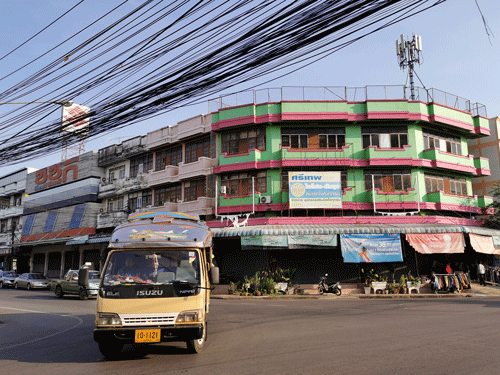
So in order to spread the word about the town, and hopefully convince a few people to check it out, I now present my unofficial top 5 reasons to visit Ubon Ratchathani town.

1) Food and markets

This is a town that loves to eat, and you'll find properly spicy Isaan, and delicious Vietnamese and Chinese-Thai food all over the city. The town centre also has modern Western-style cafés, for when you really want smashed avo on sourdough toast, and a flat white.

But forget the sourdough for today's breakfast; instead, grab a plastic stool in a local hole-in-the-wall restaurant for a steaming bowl of the city's most famous noodles, kuay jab, a porky broth with vermicelli, Vietnamese sausage and crispy fried shallots.

Porky goodness: kuay jab at 99 Kuay Jab Rot Seab

When the evening comes, the main street heading east from Thung Si Muang Park becomes a walking street, selling all kinds of food, clothing, nicknacks, and more. Stuff yourself to the gills, then go for a little walk around the park before you waddle back to your hotel.

2) Wonderfully varied temples

Temple lovers, prepare to be impressed. Temple-take-it-or-leave-its, I'll warrant you'll still find one or two to peak your interest. This is town with a huge variety of temple styles and attributes. Something for everyone!

Your first stop should probably be Wat Thung Si Muang, right in the centre of town. It's beautiful and atmospheric, especially the ho trai, a wooden scripture hall built on stilts over a lotus pond (to prevent termites reaching the sacred texts).

Elegant ho trai at Wat Thung Si Muang

Next up, and for something completely different, head to Wat Tai Prachao Yai Ong Tue. Where Thung Si Muang is classical and elegant, this one is something else entirely. The grounds and buildings are a riot of colourful statues, paintings and plants, representing everything quirky and over-the-top from Hindu and Buddhist mythology. You want giant gold and green dragons, concrete elephants, nagas, spirits, barnyard animals, dancers and gods? You got it! Spend half an hour wandering and taking it all in, and the cumulative effect is like a comic book vomited rainbows all over you. I kinda loved it.

Assaulting your eyeballs at Wat Tai Prachao Yai Ong Tue.

What's more, both temples were quiet when I visited, meaning you can explore at your leisure. And if you're a temple lover, there plenty more to explore when you're done with those two.

3) A good museum

History buffs should take a beeline to the Ubon Ratchathani National Museum. A small but well curated collection in an attractive century-old building, it gives you a good grounding in the history of the province, from pre-history, through the Dvaravati and Khmer eras, to 19th and 20th century Thai and Laos culture and craft. 

Ardhanarishvara (figure showing both male and female aspects, representing Lord Shiva and his consort Parvati)

4) Inexpensive

Without being crass, let's just admit it: Ubon Ratchathani is excellent value for visitors. I scored a comfortable room with aircon right near the walking street for 425b a night. I ate delicious noodles for 40b a pop, and even my Western café brunch of avo toast, latte, and a fruit and yogurt smoothie came to only 140b. For those coming from Laos and used to paying the sort of tourist prices found in Luang Prabang, Ubon will seem remarkably cheap.

5) Well connected

A city of 200,000 people, Ubon Ratchathani is well served with public transport options. 

The main intercity bus station is served by a plethora of minibuses and big coaches serving all major towns in the north east, as well as points further afield (Bangkok, Laos, etc.). Although, as often happens, it is situated on the outskirts of the city, sorngtaews and city buses run regularly into the centre, and the staff at the bus station were helpful and friendly.

There's a mainline train station connecting down to Bangkok (and points in between), although it's also annoyingly a bit far from the town centre (about 3.5km).

Finally, for those coming from further away, the airport is unusually close (3km) to the town centre (I walked there from my hotel in about 40 minutes when I was leaving town to head down south) and has flights with a number of budget airlines so prices are reasonable.

So where do you want to go next? Nakhon Phanom? Bangkok? Pakse and Laos? Easy peasy.


Friday, 6 December 2019

Views over Mukdahan

A modern, bustling mid-size town on the Mekong, across the river from Savannakhet and near the 2nd Thai Laos Friendship Bridge, Muk isn't a particular pretty town.

It won't win international plaudits for it's tourist attractions, and no one visits to stroll a picturesque old town (there isn't one, near as I could tell). In fact, most of the visitors appear to be Laos coming over for commerce and shopping.

But there are a couple of low-key sites to keep you busy for a day. And the mixed population (Isaan and Lao, plus plenty of Vietnamese-Thai people), means the food scene is pretty good.

And after a couple of weeks in southern Laos, staying at not-always great accommodation, the town was a nice chance to treat myself to a few days of a comfortable plush bed at an affordable, upmarket hotel.


View over midtown Mukdahan from my hotel room (I was on the 4th or 5th floor of the Ploy Palace - I can't remember exactly which floor)

Outside one of the riverside temples

Spend a few hours wandering the riverfront area, enjoying the bustling Indochine market, and the riverside temples. Then stuff yourself silly at one of the many excellent restaurants and cafes.

Get in my belly! At Ku Fat Vietnam Food

End your afternoon at Phu Manorom, a hillside park a few miles south of the centre. There you'll find tonnes of locals visiting the enormous (and as yet unfinished) seated Buddha, a gigantic naga sculpture, restaurants and picnickers, families and teenagers (most of whom seem bemused to see  Westerner). Grab a cold drink and enjoy the view back over Muk, the Mekong, and Laos.


You can cycle or walk (if you don't mind a long walk) to the hill from downtown, which goes through some quite pleasant countryside for the last part of the journey. You can also take a tuktuk, but be prepared to haggle and ensure you have correct change (the one I encountered asked me at the end of the ride for ten times what we'd agreed before I got on board).


Thursday, 5 December 2019

Back in Thailand at Nakhon Phanom

Back across the Mekong into NE Thailand at Nakhon Phanom.

I enjoyed the couple of weeks I spent exploring a few sites in Southern Laos, but I was still glad to be back in Thailand. I always am.

Nakhon Phanom is a pleasant town, spread over quite a long stretch of the river. It's friendly to Western tourists, but it doesn't feel like it sees a lot of them (apart from a steady trickle of visa-runners. FYI, I found the border crossing out of Laos and into Thailand here to be easy, friendly, and professional). 

There are a decent selection of guesthouses spread across the town, but Nakhon Phanom definitely isn't a "tourist town" where everything is geared to attracting visitors. Rather it's a prosperous-feeling mid-size town that is just getting on with living. 

Domestic tourists do come here, often to make merit at a series of important temples around the town. Vietnamese travellers also come, following in Ho Chi Minh's footsteps (Uncle Ho spent some time in a village just outside the town). But with no "famous" attractions geared to Westerners, few of us visit.

I think that should change. 

Views of the mountains in Laos from Nakhon Phanom's riverside walk

Colourful houses and vegetable gardens, seen from the Nakhon Phanom riverside boardwalk

Sure, Nakhon Phanom will never replace Chiang Mai or Ayuthaya as must-sees-on-your-first-trip-to-Thailand. Nor should it feature in the itinerary of someone who has only one week in the country to try and cram in as much fun or relaxation as possible. But for gap year tourists with plenty of time to explore Thailand, this town is well worth a night or two's stop.

The riverside has a long walkway and bike path, going past colourful houses, historic temples, riverside restaurants, and splendid views of the mountains across the Mekong in Laos. You could easily spend half a day just walking or riding a bike along the riverside, mile after mile, taking in the sites and the relaxed vibe.

Head north along the riverside, and you'll find a historic church (Saint Anna Nong Saeng, a testament to the many Vietnamese Catholics who settled in town), and a local history museum in the Former Governor's Residence (including a wonderful exhibit of traditional costumes, demonstrated in miniature versions displayed on Barbie dolls -- kudos to whomever made all those tiny, lovely costumes).

A fabulous, traditional-style house on Chayangkun Road, just south of Saint Anne.

Dolls demonstrating traditional costumes at the Former Governor's Residence Museum

The central part of the riverside houses a handsome old clocktower, Wat Okat (the most important Buddhist temple in town), the Indochine Market, the Naga Monument, and plenty of nice coffee shops and restaurants.

Head south along the riverside, and you'll pass a series of Wats, and more of those fabulous views.

And when you've worked up an appetite, there are plenty of varied places to get your refreshment on, from good quality lattes and bubble teas, to terrific Vietnamese, Isaan, and Thai-Chinese food.

If you're of a mind, you could use the town as a base to visit the various important wats outside of town, or visit the Ho Chi Minh museum in nearby Baan Na Chok. But even if you are not interested in Buddhist merit-making or Uncle Ho, that riverfront walkway is worth a night of your time. At least, I think so.

A typical street scene

One of the historical buildings scattered around the town centre

I loved the aesthetic of this (random building along the waterfront road)

The National Library


Saturday, 19 October 2019

Nong Khai: Last stop Thailand, next stop Laos

My last stop in my month on northern and NE Thailand was Nong Khai, site of the first Thai-Laos Friendship bridge and the most popular crossing between Thailand and Laos.

Nong Khai is far more than just a place to cross a border - it's a bustling town popular with domestic tourists as well as a smattering of foreigners and expats. 

There's an attractive riverfront promenade, and you can walk for miles from the bridge in the north, past Tha Sadek market, and the Naga statue, down to the sunken chedi of the former Wat Phra That Klang Nam (and it's modern recreation, built safely on the riverbank) in the south. 

The main waterfront, with the Friendship bridge just visible in the background.

Outside Tha Sadet market

The sunken chedi, Wat Phra That Klang Nam, with boat taking tourists out to make merit.

Beyond walking or cycling the promenade and enjoying the views of the Mekong and Laos, there are enough things to see in town to keep you busy for at least a couple of days, and plenty of worthwhile day trips into the surrounding countryside for those of a mind to stay longer. 

Most famous is Wat Sala Kaew Ku, also known as Wat Khaek. The life's passion of one Laos man, he sculpted more than a hundred figures from folklore, animism, Hinduism and Buddhism. It's quite remarkable. What's even more remarkable is that this was his second sculpture park. He built the first in Laos, but left it behind when he moved to Thailand in the 1970s (many Laos royalists and refugees fled to this part of Thailand after the Communist takeover of Laos in 1975).


When you're done with sightseeing and activity, there's plenty of good food in town, from modern cafés, river view restaurants specialising in barbecue fish, plenty of Isan or Vietnamese food, and plenty of night markets.

All in all, it's a pleasant place for a visit.


Vietnamese noodle soup with a view of the Mekong.

Thursday, 17 October 2019

Phu Phra Bat Historical Park

Udon Thani town doesn't seem to have much to recommend it to tourists (my old Lonely Planet lists it as a place that mostly attracts sex tourists). I found the town to be weirdly quiet and over-run by aggressive dogs at night, not a nice place to go for a walk looking for a place to have dinner... maybe I was staying in the wrong part of town? 

But I wasn't in town for Udon Thani itself — I'd come to see Phu Phra Bat Historical Park.

Getting there from Udon Thani took a little time, but was relatively simple. I first headed to Rangsina Market at the north end of town (about 3km north of the centre where I was staying, so I walked but you could take a sorngtaew).

From the main street next to Rangsina market, you can catch a sorngtaew to Ban Phue (30 baht each way, maybe 90 minutes or so. My sorngtaew stopped at the new bus station on the Western ring road en route, so the journey took a while (I don't know if they all do that detour, or if I was just unlucky). 

I alighted in Ban Phue by the Tesco Lotus. From there, you can hire yourself a motodop or tuktuk for the return trip out to the historical park. Don't expect a lot of English to be spoken there, but between a little mime, and the help of friendly locals — a young local woman came out of the shop where she worked to help translate for me — I managed to agree to hire a tuktuk and driver for half a day for 400B. From Ban Phue to the park it's about 30 min.

The park is wonderful: 

Mushroom shaped rock formations in a half-forested, half-moonscape landscape. 3000 year old cave paintings. I mean: just look at those pictures!

Prehistoric cave paintings in Tham Khon ("human cave")


Many of the rock formations had been adopted as holy sites, with Buddha sculptures added and folk legends told about them

Udon Thani you can keep, but Phu Phra Bat is well worth the effort of a visit.

A few more practicalities — the parking lot area for the park has a small restaurant that also sells cold drinks and snacks, and a brand new toilet block which is in excellent condition. 

The main pathways around the park had clearly been recently refinished, and were flat, wide, and covered in gravel, and the park offers a golf buggy service to take elderly or disabled visitors to the main sites. Some of the secondary sites are only reachable by foot, as the smaller side paths haven't been refinished yet, and are rutted and uneven in places.